Hurt People , Hurt People

Updated: Jul 26

By God’s grace, I made it through an extremely abusive childhood. Early on, I resolved never to let anyone control me again—a determination that, in many ways, became a source of strength.
Along my journey, I’ve come to recognize a few truths that shape the sojourner’s path:
Let me share a story—a sojourner’s parable—drawn from the long road of life.
There once was a weary traveler who shouldered a pack brimming with memories—some painful, some simply heavy with disappointment. As the traveler walked, they encountered others along the road, each carrying burdens of their own. Some hid their packs behind forced smiles, pretending the weight was nothing at all, while others staggered openly, nearly undone by what they bore.
One afternoon at a lonely crossroads, the traveler paused, worn and uncertain. There, beneath the shade of an old tree, sat a wise guide, quietly observing the flow of sojourners. The guide beckoned the traveler to rest. “Why do you struggle so?” the guide asked gently.
“My pack is heavy with hurts,” the traveler admitted. “No matter how far I go, I can’t seem to set it down.”
The guide smiled with understanding. “You are not alone. Every sojourner carries something. Wisdom isn’t found in throwing the pack away, but in learning which burdens to carry forward and which to finally lay down.”
With this new wisdom, the traveler carefully opened the pack. Amidst the stones of sorrow, they discovered unexpected treasures: compassion, resilience, and hope. The traveler realized that the journey—though heavy—had shaped them, not just weighed them down.
From that day forward, the traveler walked lighter, and as they journeyed, they offered a hand to others, helping them sort through their own burdens. In doing so, the traveler discovered that even on a hard road, peace could be found—and shared.
Truths I discovered in this process:
1) Hurt people hurt people.
2) If you look, there is always a silver lining in whatever you’ve been through—or are going through.
3) This too shall pass.
4) You can either get better or get bitter.
Let’s begin with the first truth,
Hurt people hurt people—a lesson that took me years to truly understand.
I credit God for any wisdom I have gained. He’s given me a gift for seeing not just what is, but what could be—in people, situations, and even spaces. This vision has guided me both emotionally and creatively. I am a visionary for sure.
Of course, I didn’t recognize any of these truths as a child—who could? But I never hated or disliked my father. I was deeply afraid of him, yet I always felt a measure of compassion for him.
With age comes the vantage point to see a bigger picture.
My father was raised in a poor Italian family, living with an alcoholic father, surrounded by affluence in a Chicago suburb. Bullying wasn’t named as such back then, but I’m certain he was ridiculed. That left him feeling insecure and less than.
I’m not a psychologist, but I believe that childhood insecurity—whether from neglect, abuse, or loss—follows you into adulthood. It shapes your behavior and your reactions to events beyond your control.
For my father, that pain became anger, and his anger often spilled over as abuse toward his children.
If our home life existed today, my father would likely have spent much of his adult life in prison. I endured every kind of abuse—physical, emotional, some you wouldn't want me to mention, even broken bones.
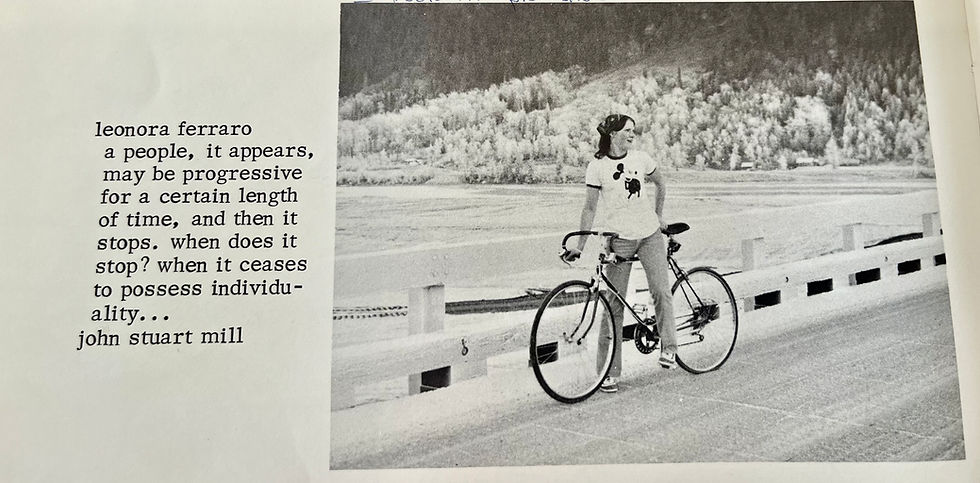
He moved us to Alaska because it was a safe place for him to do whatever he wanted. Everyone looked the other way in Alaska back then. I remember my (step)mother calling the neighbors one night, asking if we could bring our guns over to their house because she was "afraid he was going to kill us that night". The neighbors just said, "Sure, let us know when you want them back".That was Alaska back then.
I always promised myself I’d never be like him.
But when I finally left home (the “escape from Alcatraz” I mentioned in an earlier post), I realized I had become just like him.
The difference was that I recognized it—and began a lifelong journey to change that pattern within myself.
And I do mean a lifetime of intentional work.
That initial history left me with self-hatred, depression, and anger of my own.
Part of my healing process (I’m not there yet)—speaking only from experience—was learning to get rid of the rearview mirror. You can’t drive forward by looking in the rearview mirror, or even by focusing on the hood ornament; you have to look down the road ahead.
Knowing this didn’t make it easy, but it served as a reminder to keep letting go.
As I said, I never hated him, and in my heart, there was nothing to “forgive”—I always understood he was hurt and taking it out on us, and on our animals. That’s another heartbreaking story, but it’s also what made me a strong animal advocate. Animals don’t have a voice; people do.
I made it out alive; sadly, our animals did not.
Late in life, my father once told me, “I envy your life.” I asked him what he meant, and he replied, “You’re successful, happily married, and seem so content.” I told him, “Dad, the only difference between us is that I put the past behind me.” He had marinated his entire life in what happened during his first fifteen years of his life, never put it down, never let it go. He just became angerier and angrier. He’d even illegally joined the Marines at seventeen, searching for a place to belong.
Moral of this story: put away the rearview mirror—and, if you need to, forgive. That’s how you take the next step, find resolution, and eventually experience peace. For me, it’s been a lifelong journey, and I’ll keep walking it until the day I meet Jesus face to face.


Comments